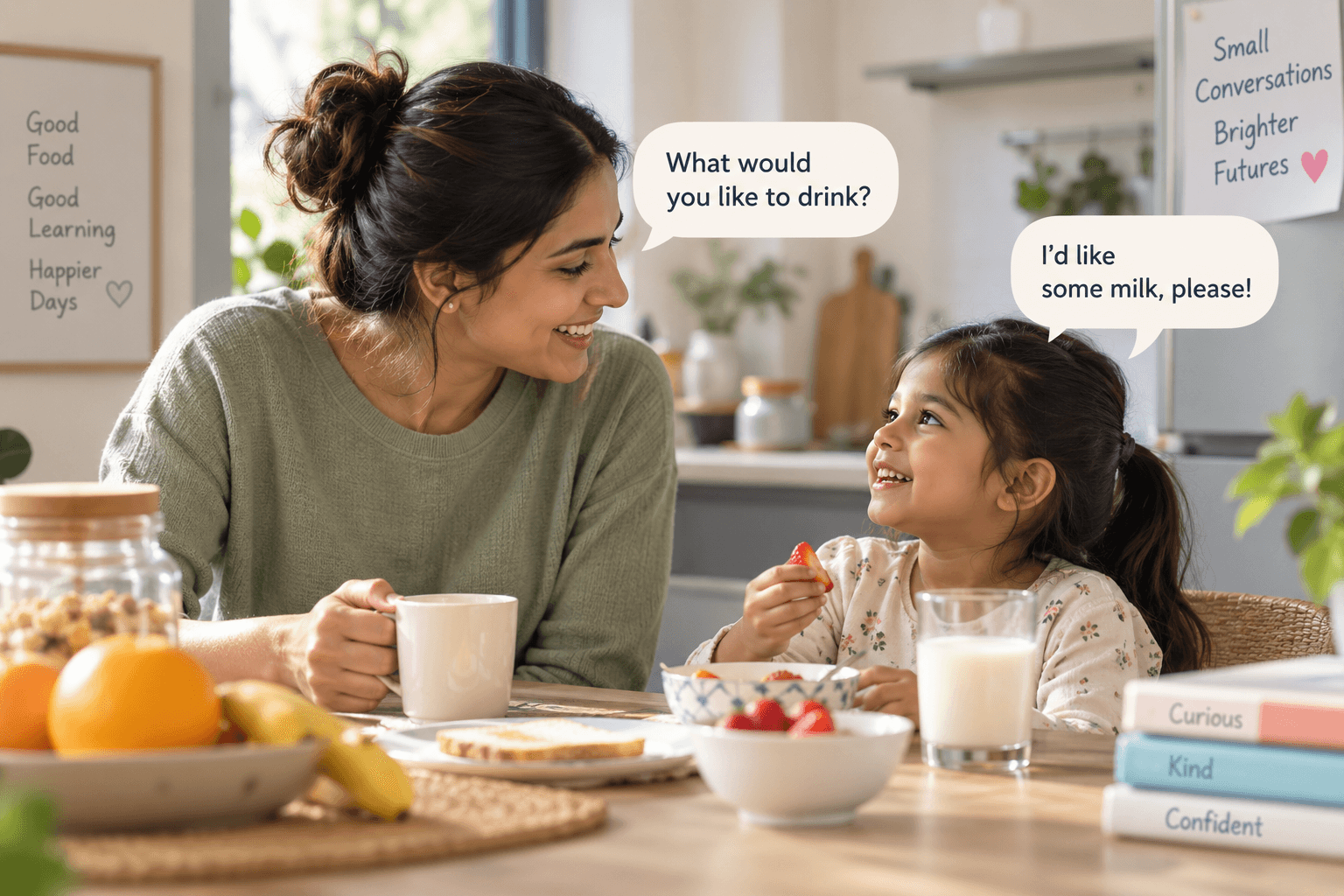
You don’t need to turn your home into an English classroom. A few minutes of natural conversation can give your child useful opportunities to hear English, try words, build sentences and use them again. If your child already understands more than they say, this is a common stage, and the same small routines below can help.
Try making English part of moments that are already happening. Keep the language short, familiar and useful.
- Start with things your child already knows.
- Ask simple questions and give them time to answer.
- Model useful phrases instead of correcting every mistake.
- Reuse the same words in different situations.
- Keep practice relaxed and short enough to feel manageable.
Why everyday conversations can help
Familiar routines give children context. They already know what breakfast is, what clothes they are choosing, what they are playing with and what happens before bed. That context can make it easier to connect English with something meaningful.
Parents can also use very simple English. The goal isn’t to turn every interaction into a lesson. It is to create small reasons to listen, answer, ask and use language.
The Flucie way
Flucie’s approach starts with something the child can see or experience, then moves toward language they can actually use.
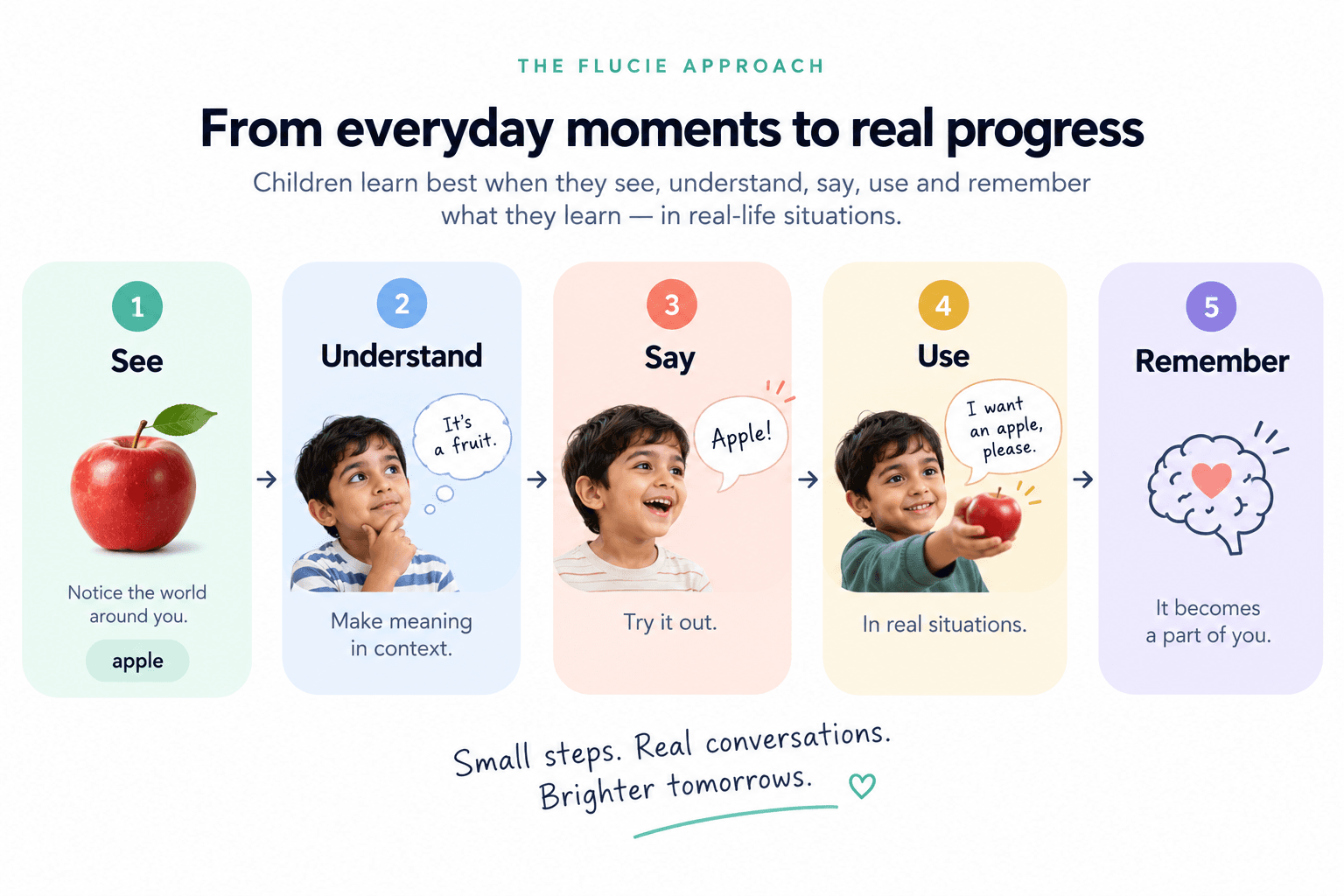
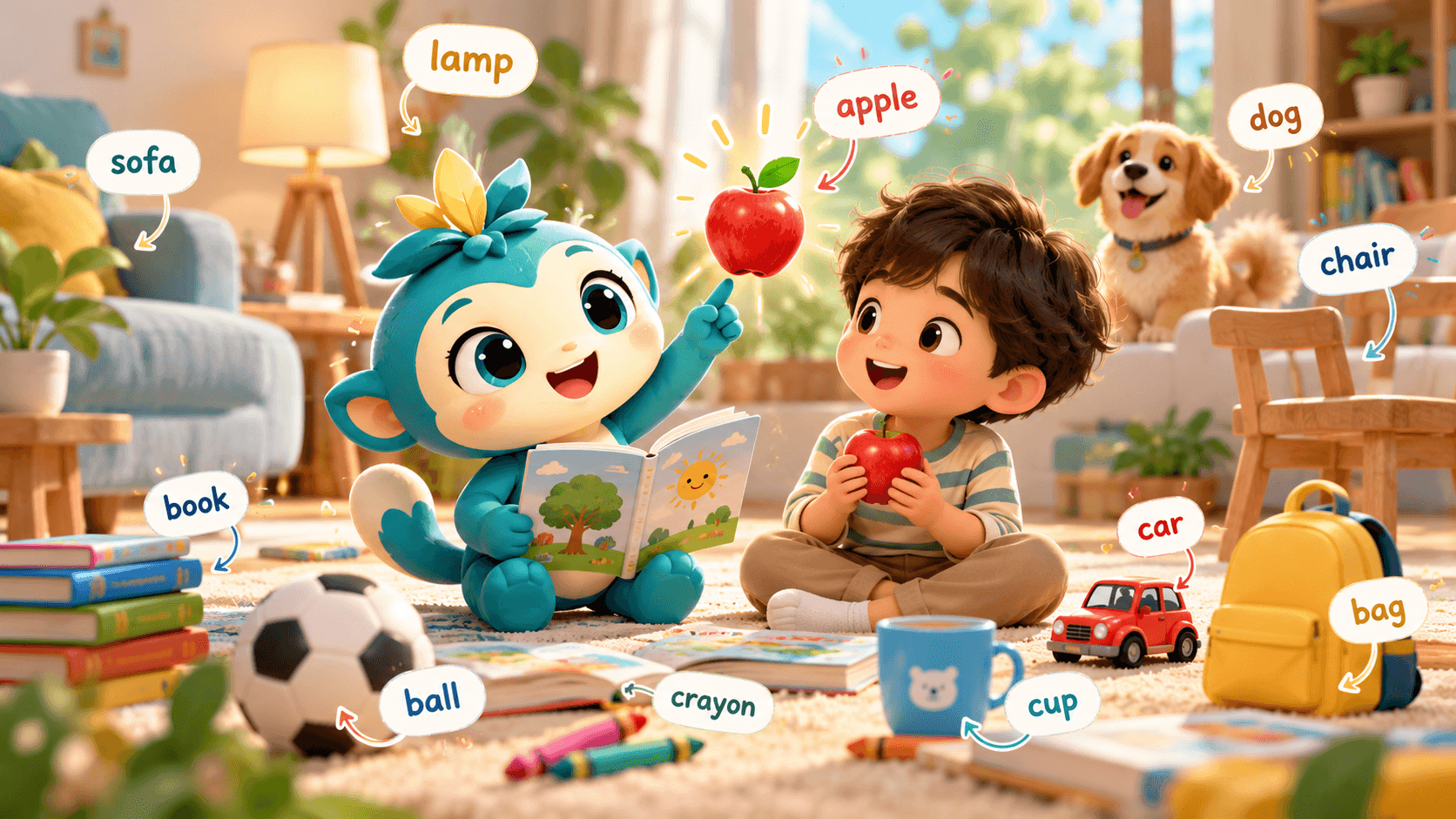
For example, a child sees an apple. You name it: “It’s an apple.” They try “Apple!” Then you give them a reason to use it: “I want an apple.” When the word appears again later, it becomes part of something familiar rather than an isolated vocabulary item.
Seven places to practise English at home
1. Breakfast
Talk about choices, food and tastes.
“What would you like?”
“Milk or water?”
“What are you eating?”
2. Getting dressed
Use clothes, colours and everyday English words.
“What colour is your shirt?”
“Where are your socks?”
“Which one do you want?”
3. Tidying the room
Turn ordinary instructions into small conversations, using words like big, small, empty and full.
“Where does this go?”
“Can you find the red car?”
“Put the book on the shelf.”
4. Cooking
Cooking naturally creates opportunities to talk about ingredients, actions and choices.
“Can you find the spoon?”
“Is this hot or cold?”
“What should we add next?”
5. Shopping
Use the things around you to encourage questions and simple choices.
“Can you find the apples?”
“How many do we need?”
“What should we buy?”
6. Play
Imaginative play can make it easier to start conversations without making them feel like practice, especially with toy animals and the sounds they make.
“What are we making?”
“Where are we going?”
“What happens next?”
7. Bedtime
Slow down and use the end of the day for simple reflection, including words for how the day felt.
“What was your favourite part of today?”
“What did you see?”
“Who did you play with?”
For more questions like these, organised by moment, see 50 English conversation questions for kids.
Don’t correct everything
When every sentence is interrupted, speaking can start to feel like a test. Instead, try modelling the natural phrase and keeping the conversation moving.
Child: “I want apple.”
Parent: “Sure. I want an apple too.”
You don’t have to ignore mistakes forever. The useful habit is to avoid turning every attempt into a correction exercise.
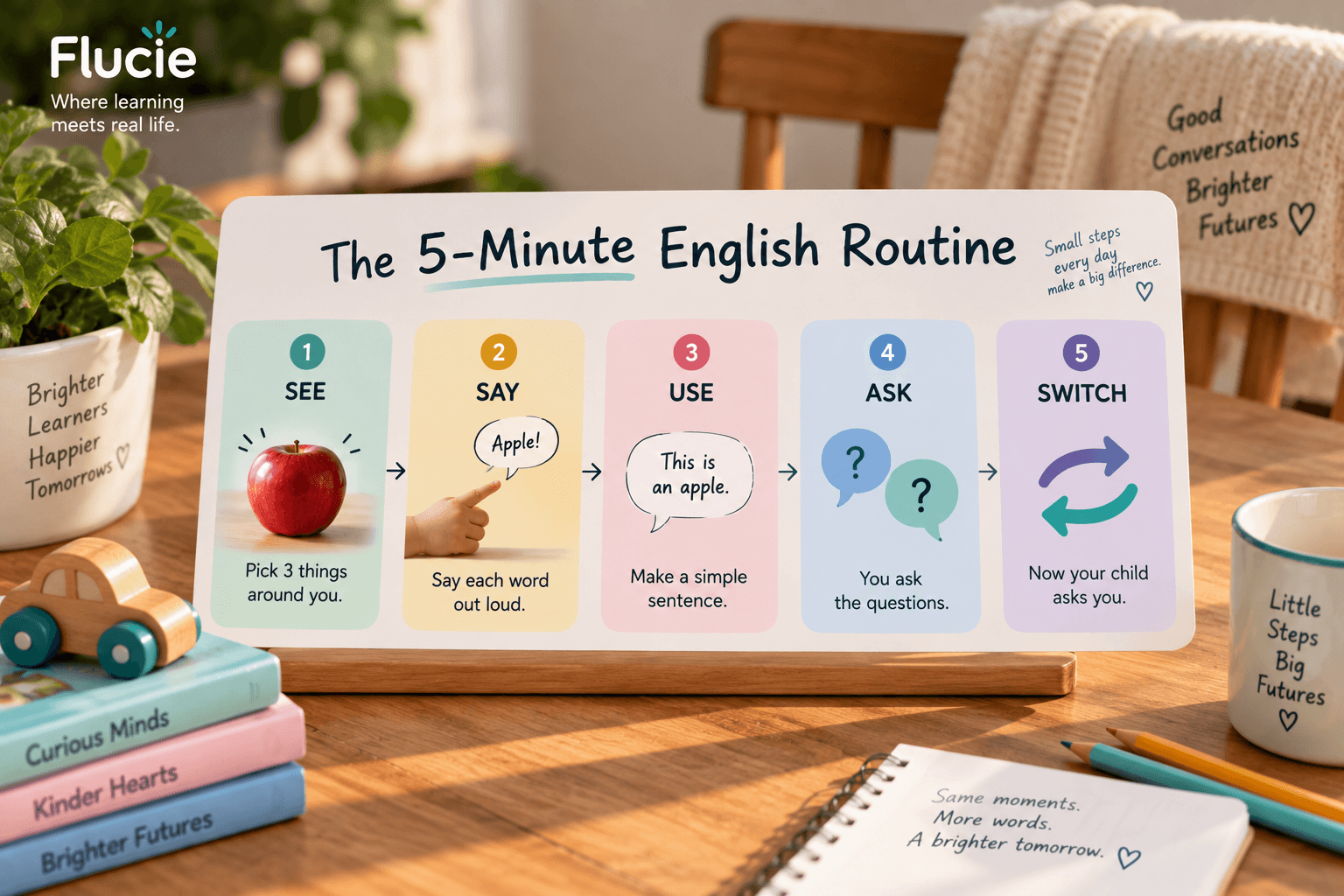
Try a 5-minute English routine
When you only have a few minutes, keep the routine simple:
Pick three things around you.
Say each word aloud together.
Make a simple sentence with one word.
Ask your child a question using one of the words.
Let your child ask you a question.
If your home language is Hindi or Telugu
Speaking Hindi or Telugu at home does not hold back a child’s English. Children can build more than one language at the same time, and a strong home language gives them something to connect new English words to rather than something to compete with it. You do not need to switch the household to English, and mixing languages in the same sentence while a child is learning is normal, not a mistake to correct. For what the research actually shows, see will speaking Hindi or Telugu at home slow down my child’s English?
A simple routine that works in a Hindi or Telugu-speaking home: say the word in English, then in the home language, then use it in a short English sentence. “Apple. सेब. I want an apple.” The 100 easy English words and colours, numbers and shapes lists are a good place to start this routine, and daily routine words carry it through the rest of the day.
Build reading alongside speaking
Speaking and reading reinforce each other. Once your child is comfortable saying a word aloud, reading it on a page makes it stick further. Easy English sentences to read is a good next step once a child knows a few dozen words, and Flucie’s own Read-to-Me highlights words as a child reads them aloud.
You don’t have to be an English teacher
You can help your child practise without planning a formal lesson. Focus on modelling simple language, repeating useful phrases, asking manageable questions and giving your child time to respond.
If you aren’t confident speaking English yourself, keep your language simple and use trusted children’s books, songs or learning resources alongside everyday practice.
Build repetition into normal life
The same word can become more useful when it appears in different contexts.
APPLE
Breakfast: “Do you want an apple?”
Shopping: “Can you find the apples?”
Snack: “Is the apple red or green?”
That small change, from seeing a word once to using it several ways, is what makes everyday practice valuable.
Try it with Flucie
Flucie: “What would you like to drink?”
Child: “Juice.”
Flucie: “You can say: I’d like some juice, please.”
Your turn.
This is a product preview showing the learning pattern, not a live AI conversation.
Want your child to try a version of this themselves? Flucie Create turns a simple colouring activity into a word-and-sentence practice they can finish in a few minutes.
What not to do
Try not to make every English interaction a test.
- Don’t correct every sentence.
- Don’t force long answers.
- Don’t ask too many questions at once.
- Don’t translate every word automatically.
- Don’t make mistakes feel embarrassing.
- Don’t expect instant fluency.
Instead, keep practice short, useful and connected to what your child is already doing.
The goal isn’t more English. It’s more useful English.
You don’t need to fill every part of the day with English. A few meaningful opportunities can be enough to start.
When children can connect words to things they see, choices they make and situations they recognise, English becomes something they use, not just something they study.
When should you expect progress?
Every child develops at a different pace, so there isn’t a useful promise of fluency after a fixed number of days or weeks.
Instead, look for small changes: answering more often, using familiar phrases independently, asking simple questions, combining words into sentences and reusing vocabulary in new situations.
Frequently asked questions
How can I encourage my child to speak English at home?
Start with familiar situations, ask short questions, model useful phrases and give your child time to answer. Keep the pressure low and reuse language during everyday routines.
What if my child understands English but answers in another language?
Keep offering simple English without turning the exchange into a test. You can model a short English response and continue the conversation naturally.
How long should English practice at home last?
It doesn't need to be a long lesson. Short, regular moments can fit naturally into routines such as breakfast, play or bedtime.
How can I practise English if I'm not confident speaking it myself?
Use simple phrases you are comfortable with, repeat them consistently and use trusted children's books, songs or learning resources for additional input.
What are some easy English speaking activities for kids?
Describe objects around the house, make choices at breakfast, talk while cooking, role-play a shop or restaurant, and ask simple questions about the day.
Sources & further reading
- British Council LearnEnglish Kids: Speaking English at home
- Cambridge English: How to encourage your child to speak confidently in English
- British Council LearnEnglish Kids: Top tips
- British Council LearnEnglish Kids: Motivating your child
Flucie’s article is original educational content. The sources above informed the practical guidance; they are not reproduced here.
Keep reading
 English Speaking
My child understands English but doesn't speak. What can I do?
If your child follows English but rarely answers in it, there are simple ways to make speaking feel easier.
 English Speaking
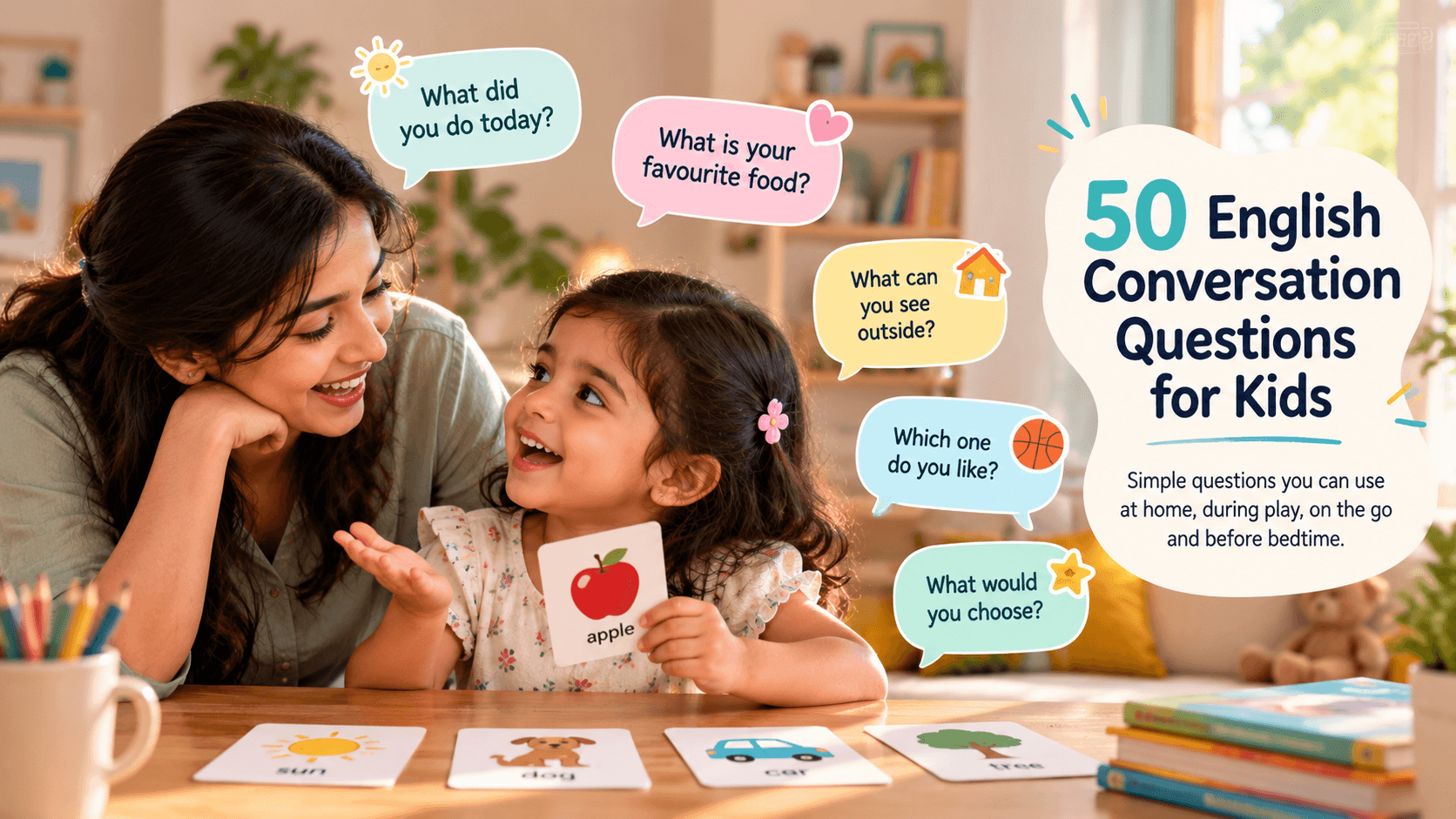
50 English Conversation Questions for Kids
Fifty simple questions you can use at breakfast, during play or before bedtime to get your child talking in English.
 Vocabulary
100 Easy English Words for Kids to Learn at Home
Simple everyday vocabulary children can see, hear, say and use, with a short example sentence for every word.
Written by the Flucie team. See how we make our content or send a correction to hello@flucie.com.
Make everyday moments count.
Flucie is being built around stories, reading, speaking and real-life practice, so children can use English for something, not just answer a worksheet.
Explore Flucie