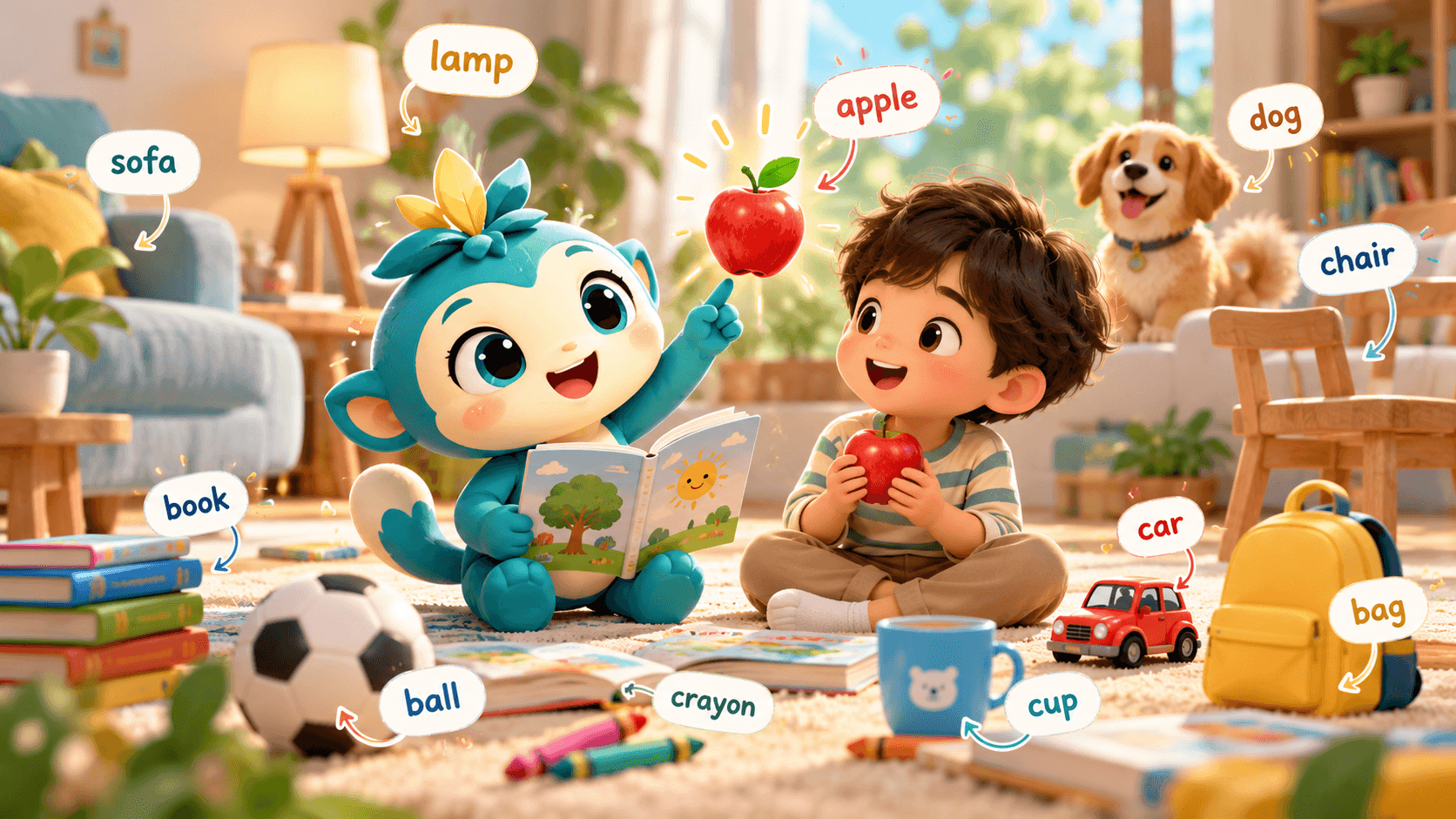
Children do not need hundreds of flashcards to start building useful English vocabulary. Many of the easiest English words for kids are already around them, in the kitchen, the bedroom, the school bag, the garden and the daily routine.
This guide gives you 100 easy English words to learn at home, with a short example for each. You do not need to learn all 100 at once. Pick a few, then help your child notice each word, understand it, say it and, with time, use it without thinking.
Start with words your child can actually see or touch. Real objects make vocabulary meaningful.
All 100 words and examples on 7 A4 pages, with tick boxes and the games from this guide. Free to print for home or classroom.
100 everyday English words for kids
The words are grouped into ten everyday topics, so you can pick the group that matches what is happening around your child right now. Each word has one very short sentence you can read aloud.
1. Around the house
| Word | Simple example |
|---|---|
| door | Close the door. |
| window | Open the window. |
| chair | Sit on the chair. |
| table | The book is on the table. |
| bed | My bed is soft. |
| pillow | This is my pillow. |
| lamp | Turn on the lamp. |
| floor | The toy is on the floor. |
| wall | The picture is on the wall. |
| room | This is my room. |
2. Food
| Word | Simple example |
|---|---|
| apple | I have an apple. |
| banana | The banana is yellow. |
| bread | I like bread. |
| rice | The rice is warm. |
| milk | I drink milk. |
| egg | The egg is round. |
| water | I need some water. |
| cheese | The cheese is soft. |
| cake | The cake looks good. |
| orange | This orange is sweet. |
3. Kitchen words
| Word | Simple example |
|---|---|
| plate | Put it on the plate. |
| cup | My cup is blue. |
| spoon | Use a spoon. |
| fork | Where is the fork? |
| bowl | The soup is in the bowl. |
| pan | The pan is hot. |
| fridge | The milk is in the fridge. |
| sink | Wash it in the sink. |
| knife | The knife is sharp, so be careful. |
| bottle | Fill the bottle with water. |
4. Clothes
| Word | Simple example |
|---|---|
| shirt | I am wearing a shirt. |
| pants | These pants are blue. |
| dress | She has a red dress. |
| shoe | Where is my shoe? |
| sock | Where is my other sock? |
| hat | Put on your hat. |
| jacket | My jacket is warm. |
| The coin is in my pocket. | |
| belt | My belt is black. |
| bag | My bag is heavy. |
5. Body parts
| Word | Simple example |
|---|---|
| head | Touch your head. |
| hair | My hair is wet. |
| eye | Close one eye. |
| ear | Touch your ear. |
| nose | This is my nose. |
| mouth | Open your mouth. |
| hand | Raise your hand. |
| finger | Point with your finger. |
| leg | My leg is tired. |
| foot | Stamp your foot. |
6. Animals
| Word | Simple example |
|---|---|
| dog | The dog can run. |
| cat | The cat is sleeping. |
| bird | The bird can fly. |
| fish | The fish is in the water. |
| cow | The cow eats grass. |
| horse | The horse is brown. |
| rabbit | The rabbit has long ears. |
| elephant | The elephant is big. |
| monkey | The monkey can climb. |
| butterfly | The butterfly has wings. |
7. Things children play with
| Word | Simple example |
|---|---|
| ball | Kick the ball. |
| doll | My doll has a dress. |
| car | The toy car is fast. |
| block | Put the block here. |
| puzzle | I finished the puzzle. |
| game | Let’s play a game. |
| book | Read the book. |
| crayon | Use a blue crayon. |
| bike | I can ride my bike. |
| kite | The kite is flying. |
8. School words
| Word | Simple example |
|---|---|
| school | I go to school. |
| teacher | My teacher is kind. |
| student | She is a student. |
| class | Our class is fun. |
| desk | My book is on the desk. |
| pencil | I need a pencil. |
| eraser | Use the eraser. |
| paper | Write on the paper. |
| notebook | Write it in your notebook. |
| lesson | The lesson starts now. |
9. Everyday actions
| Word | Simple example |
|---|---|
| eat | Let’s eat. |
| drink | Drink some water. |
| walk | Let’s walk outside. |
| run | I can run fast. |
| jump | Jump over the line. |
| sit | Please sit here. |
| stand | Stand up. |
| open | Open the box. |
| close | Close the book. |
| help | Can you help me? |
10. Words for talking about the world
| Word | Simple example |
|---|---|
| sun | The sun is bright. |
| moon | The moon is in the sky. |
| star | I can see a star. |
| tree | The tree is tall. |
| flower | The flower is pretty. |
| rain | It is raining. |
| cloud | The cloud is white. |
| road | We crossed the road. |
| sky | The sky is blue. |
| home | We are going home. |
Don’t try to teach all 100 words at once
Treat this kids English vocabulary list as a reference to dip into. English vocabulary for children grows best when a few words are tied to something real in their day. Pick three to five words that fit what your child is doing, and stay with them for a few days.
- Choose words connected to what is in front of your child right now.
- Say them while you are already doing something, like eating or getting dressed.
- Bring the same words back naturally, at the next meal or the next game.
- Skip the quiz. If your child tries a word, that is enough.
Example. At breakfast, choose plate, spoon, cup, bread and milk. Point to each one, say the word, and let your child use it in a tiny sentence.
The 5-step way to learn a new word
This is the idea behind how Flucie is designed. A word sticks when a child goes through all five steps.
Here is what the five steps look like with one word, apple.
See. Hold up a real apple. Let your child look at it and touch it.
Understand. “This is an apple. We eat it. It is red.”
Say. “What is it?” “Apple.”
Use. “What colour is it?” “Red.” “Can I have an apple, please?”
Remember. The next day, at snack time, ask “Where is the apple?” Meeting the word again in a new moment is what makes it stay.
A simple 5-minute English game
This works with any group of words in the tables above. It needs no materials, only a room.
Find it. Say it. Use it.
- Pick one room, such as the kitchen or the bedroom.
- Ask your child to find three things they already know.
- Ask them to say each English word.
- Choose one word and make a short sentence together.
- Tomorrow, find the same word again and ask a slightly different question.
Make vocabulary part of real life
You do not need a separate study time. These everyday English words show up in moments that already happen.
Once your child can name things, the 50 English conversation questions give you more to ask about them.
What if my child knows the word but doesn’t speak?
Knowing a word and using a word are two different skills. A child may recognise apple straight away and still hesitate when asked for a sentence. This is common, and it usually improves with small, low-pressure chances to answer.
Build up one step at a time:
apple → red apple → I see a red apple.
Perfect grammar can wait. What matters is that speaking feels easy enough for your child to keep trying. If this sounds like your child, this guide goes deeper, and these everyday routines give you practical ways to start.
Turn these 100 words into a game
Games give children a reason to look, think and speak. Any of these works with the words in this list.
- I Spy. “I spy something that starts with b.” Banana, bed, bag or ball.
- Object hunt. Call out a word and let your child bring you the object.
- Sorting. Put things into groups: food, clothes, toys.
- Draw and label. Draw a cat or a kite, then write or say the word next to it.
- What’s missing? Put three or four objects on a table, remove one while your child looks away, and ask what changed.
Prefer paper? The printable PDF has every word, a tick box for each and these games on one set of pages.
For a version your child can do on screen, Flucie Create turns words like apple, dog and bag into a short colouring and speaking activity.
More word lists
Once these feel familiar, try the lists for colours, numbers and shapes, daily routine words, opposites, animal names and sounds and feelings words. When your child is ready to read, try the easy sentences to read. Each one has its own free printable.
The best English classroom may already be around you
A bedroom has a bed, a pillow and a lamp. A kitchen has a cup, a plate and a spoon. A walk has trees, roads, cars and flowers. Every day gives children many chances to connect an English word with something they can see and use.
Start small. Choose a few words. Help your child notice them, understand them, say them and use them. Then come back to them tomorrow.
Frequently asked questions
What English words should kids learn first?
Start with familiar words connected to the child's real environment: people, food, toys, clothes, body parts, rooms and everyday actions. Words a child can see and touch are the easiest to remember.
How many English words should a child learn in a day?
There is no single number that works for every child. Three to five words is a comfortable starting point, and a few words used again and again in real moments are worth more than a long list learned once.
How can I teach English at home if I am not fluent?
Use the simple words and short phrases you are comfortable saying. You can learn alongside your child, use real objects as prompts, and repeat the same words in daily routines.
How can I help my child remember new English words?
Bring the same words back across different days and situations. Seeing the object, saying the word and using it in a short sentence helps a word become familiar.
My child understands English but doesn't speak. What should I do?
Give low-pressure chances to say small things: one word, then a choice, then a short sentence. Avoid turning every mistake into a correction, and keep the moments short.
Should children learn vocabulary using flashcards?
Flashcards can help, but they work best alongside real objects, pictures, stories, questions and speaking. A word tied to something your child can see and use is easier to remember than a card on its own.
Keep reading
 English Speaking
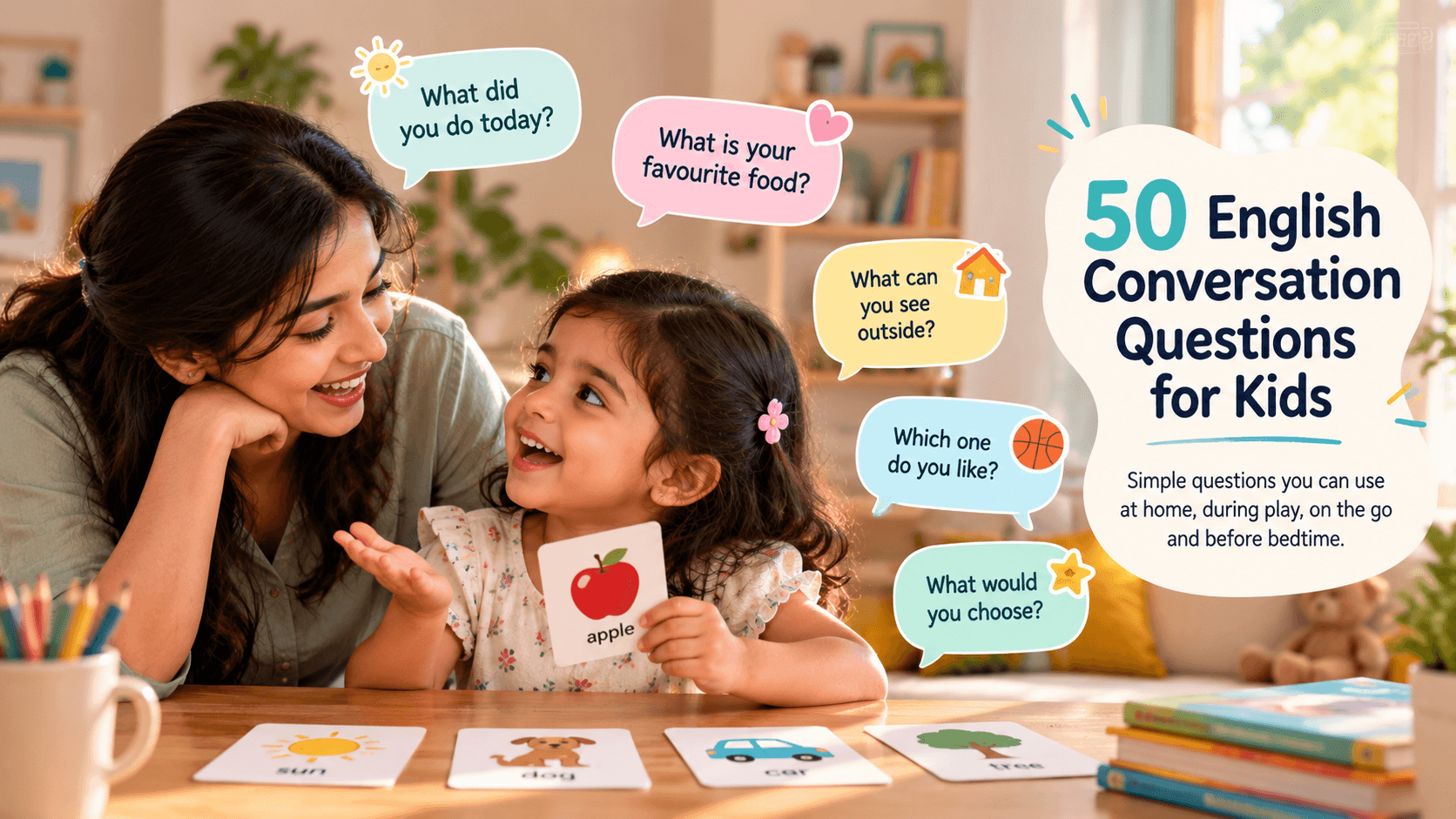
50 English Conversation Questions for Kids
Fifty simple questions you can use at breakfast, during play or before bedtime to get your child talking in English.
 English Speaking
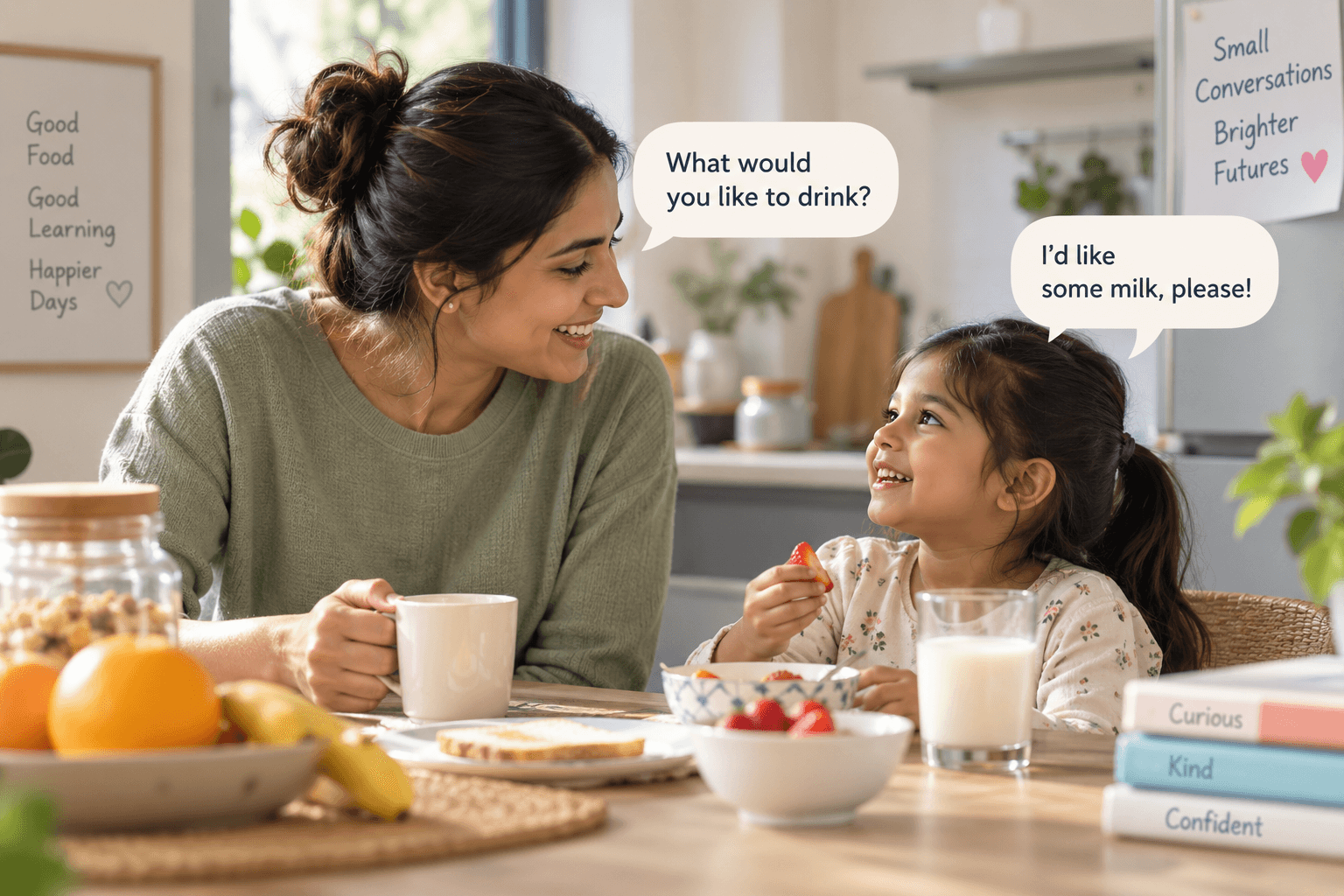
How to Help Your Child Speak English at Home
Simple ways to turn everyday moments into meaningful English conversations.
 English Speaking
My child understands English but doesn't speak. What can I do?
If your child follows English but rarely answers in it, there are simple ways to make speaking feel easier.
Written by the Flucie team. See how we make our content or send a correction to hello@flucie.com.
Turn everyday moments into learning.
Flucie helps children learn English through stories, reading, speaking and real-life practice with an AI learning guide.
Explore Flucie Create