Some words sound the same, or almost the same, but mean different things. A spelling checker cannot always catch these because each word is spelt correctly. It is just the wrong word for the sentence. Here are 12 pairs and groups that cause the most trouble, with the meaning and an example for each.
When you are unsure, say the meaning in your own words and check it against the table below. Then write a sentence of your own for the word you chose. If the sentence makes sense, you have the right one.
12 confused words, with examples
| Words | Meaning | Example |
|---|---|---|
| their / there / they’re | their = belonging to them; there = a place; they’re = they are | Their bags are over there. They’re late. |
| your / you’re | your = belonging to you; you’re = you are | You’re sure that is your pen? |
| its / it’s | its = belonging to it; it’s = it is or it has | It’s a dog that wags its tail. |
| to / too / two | to = towards; too = also or very; two = the number 2 | I am going to the shop too. I want two apples. |
| affect / effect | affect = to change something (verb); effect = the result (noun) | The rain will affect the match. The effect was a delay. |
| then / than | then = at that time or next; than = used to compare | First we eat, then we play. She is taller than me. |
| loose / lose | loose = not tight; lose = to misplace or not win | My shoe is loose. I do not want to lose it. |
| advice / advise | advice = a suggestion (noun); advise = to give advice (verb) | I advise you to take my advice. |
| accept / except | accept = to receive; except = apart from | Everyone came except Ravi. He did not accept the invitation. |
| principal / principle | principal = head of a school, or main; principle = a rule or belief | The principal explained the principle of fair play. |
| stationary / stationery | stationary = not moving; stationery = paper, pens and supplies | The bus was stationary outside the stationery shop. |
| whether / weather | whether = if; weather = rain, sun and so on | I wonder whether the weather will change. |
Why a spelling checker may miss these
A spelling checker looks at each word on its own and asks whether it is a real word. “Their” and “there” are both real words, so neither is flagged, even if you use the wrong one. Spotting these mistakes means thinking about the sentence, which is a job for you, or for a grammar tool. The Flucie spelling checker only checks spelling, and it says so, so use this list alongside it.
Easy tricks for the hardest ones
- Their / there / they’re. “There” has the word “here” inside it, and both are places. “They’re” is “they are” with the apostrophe in place of the missing a.
- Its / it’s. Try replacing it with “it is”. If that works, use it’s. If not, use its.
- Affect / effect. A is for action, E is for end result. Affect is the action, and effect is what you are left with at the end.
- Principal / principle. The principal is your pal (a person). Principle ends in -le, like rule.
Practise the ones you get wrong
Do not try to learn all 12 at once. Choose the two or three you mix up and write a sentence for each. Put the sentences on a card and read them again after a day, then after three days. The spelling practice sheet maker can turn your own list into a printable sheet.
Related reading: 20 common spelling mistakes in English and British vs American spelling.
Frequently asked questions
What is the difference between their, there and they're?
Their means belonging to them, there means a place, and they're means they are. Example: Their bags are over there. They're late.
What is the difference between affect and effect?
Affect is usually a verb meaning to change something. Effect is usually a noun meaning the result. The rain will affect the match, and the effect was a delay.
How do I know whether to use its or it's?
Replace it with it is. If the sentence still makes sense, use it's. If not, use its.
Why does a spelling checker not catch these mistakes?
Each word is spelt correctly. The mistake is using the wrong word for the sentence, which a spelling checker, which looks at words one at a time, usually cannot see.
What is the difference between loose and lose?
Loose means not tight. Lose means to misplace something or not to win.
Keep reading
20 Common Spelling Mistakes in English and How to Fix Them
Twenty words that are often misspelt, why they go wrong, and an easy memory hook for each one.
British vs American Spelling: The Main Differences
The main spelling differences between British and American English, the simple rules behind them, and which one to use.
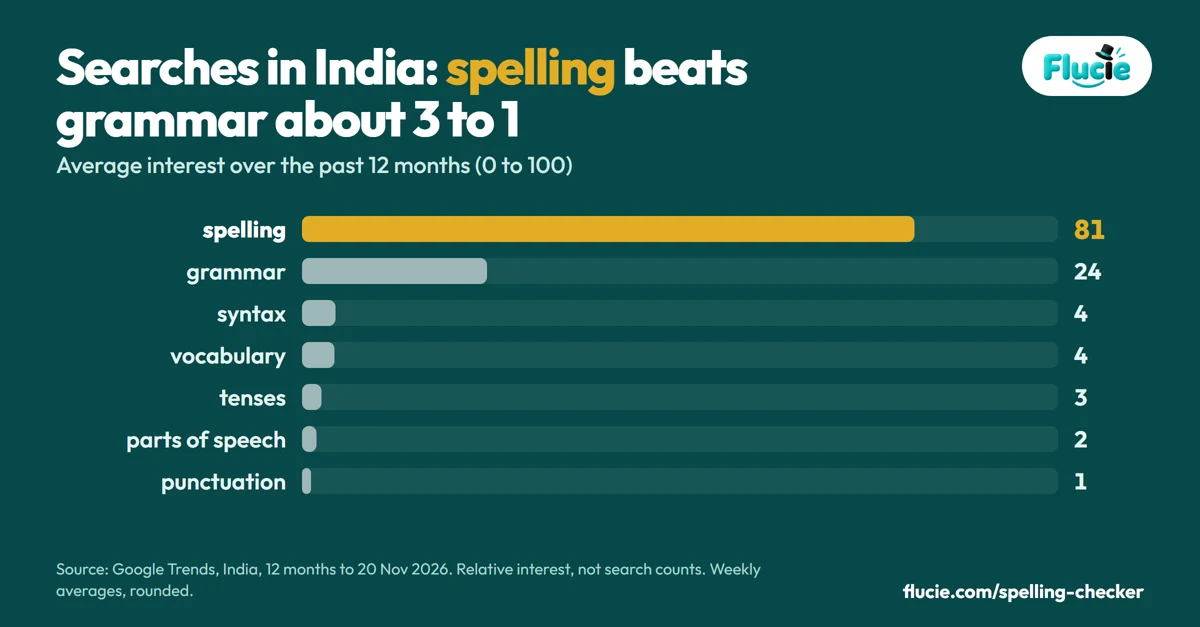 Spelling
Why Indians Search for “Spelling” Three Times More Than “Grammar”
A look at 12 months of Google Trends data for India, what the gap might mean, and five things that help with spelling.
Written by the Flucie team. See how we make our content or send a correction to hello@flucie.com.
Practise your own mistakes.
Turn the words you get wrong into a printable practice sheet. Free, and it runs in your browser.
Make a practice sheet