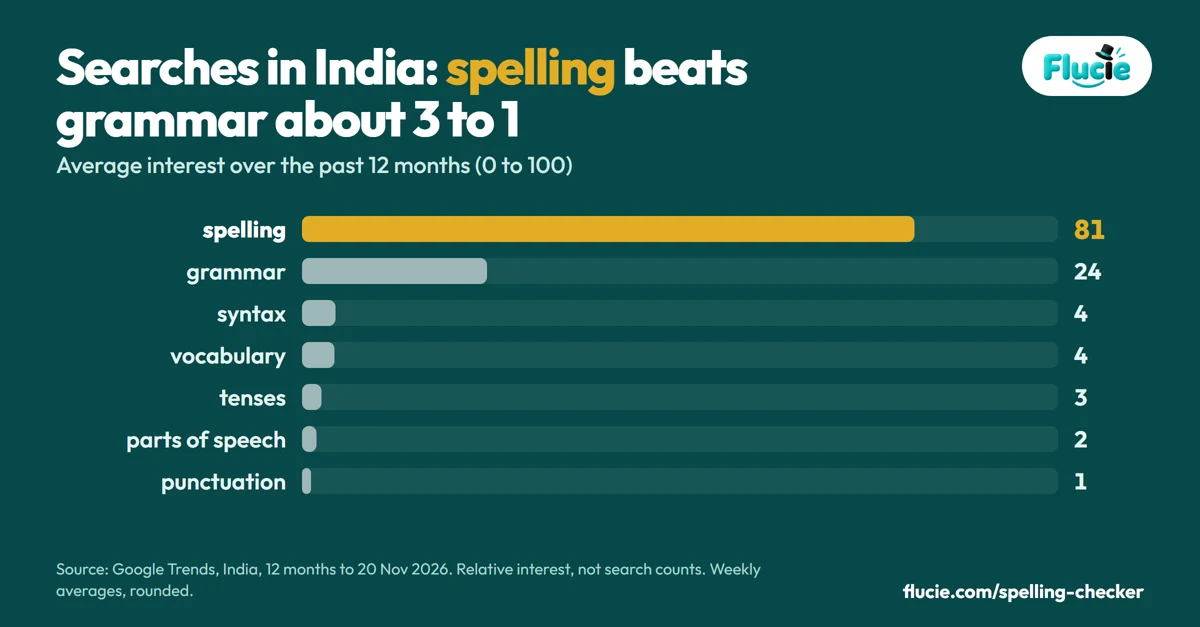
In Google Trends for India, “spelling” gets about three times the search interest of “grammar”. Here is what that data shows, what it does not show, and what tends to help when spelling is the problem.
Over the 12 months to 20 November 2026, “spelling” averaged about 81 on Google’s 0 to 100 scale in India. “Grammar” averaged about 24. Syntax, vocabulary, tenses, parts of speech and punctuation were each in the low single digits.
What the data shows
We compared seven English-learning words in Google Trends for India: spelling, grammar, syntax, vocabulary, tenses, parts of speech and punctuation. Spelling was clearly highest. It also follows the school year: interest climbs through the year, peaked in September, and dips in December and January.
What it does not show
Google Trends shows relative interest, not the number of searches. A one-word search like “spelling” can mean different things: checking how to spell a word, looking for a spelling bee, or wanting to learn. Grammar is also often searched in longer phrases, which a single-word comparison does not capture. So this is a pattern worth noticing, not proof that spelling matters more than grammar.
Why spelling might stick
This is our reading, not a finding. Grammar can feel abstract. Spelling is concrete and public: a wrong letter in an email, a job application or a school note is visible to everyone, and it is easy to feel embarrassed by it. A small, specific problem is also easier to fix than “improve my English”.
What tends to help with spelling
- Practise your own mistakes, not a generic list. The words you actually get wrong are the ones worth ten minutes.
- Look, say, cover, write, check. Look at the word, say it in parts, cover it, write it from memory, then check. Repeat on three different days.
- Use a memory hook for stubborn words. Necessary has one collar and two sleeves: one c, two s.
- Check real writing. Paste an email or a paragraph into a checker, see which words were flagged, and practise those.
- Keep it short. Five to ten words at a time is easier to finish than fifty.
A free tool, if it helps
The Flucie spelling checker runs in your browser. Paste your writing, see doubtful words underlined, and fix each one in a tap, in British or American spelling. It does not check grammar, and your text is not sent to us. One button turns your mistakes into a printable practice sheet.
For younger learners
If you are helping a child, start with the 100 easy English words list or the easy English sentences for reading practice.
Frequently asked questions
Do people in India search for spelling more than grammar?
In Google Trends data for India over 12 months to 20 November 2026, “spelling” averaged about 81 on Google’s 0 to 100 scale and “grammar” about 24. Trends shows relative interest, not search counts.
Does this mean spelling matters more than grammar?
No. It only shows what people search for. A one-word search like “spelling” can also mean a spelling bee or checking one word, and grammar is often searched in longer phrases.
When is interest in spelling highest?
It follows the school year. Interest climbs through the year, peaked in September, and dips in December and January.
What helps most with spelling?
Practising your own mistakes, using look, say, cover, write, check on three different days, a memory hook for stubborn words, and five to ten words at a time.
Is there a free spelling checker?
Yes. The Flucie spelling checker runs in your browser, underlines doubtful words in British or American spelling, and does not check grammar. Your text is not sent to Flucie.
Sources & further reading
Flucie’s article is original educational content. The sources above informed the practical guidance; they are not reproduced here.
Keep reading
 Vocabulary
100 Easy English Vocabulary Words for Kids to Learn at Home
Simple everyday vocabulary children can see, hear, say and use, with a short example sentence for every word.
Easy English Sentences for Kids to Read
Thirty two short sentences in four reading levels, each with a question to ask, and a free printable reading sheet.
The 8 Parts of Speech for Kids, With Examples
Noun, pronoun, verb, adjective, adverb, preposition, conjunction and interjection, explained in one plain line each.
Written by the Flucie team. See how we make our content or send a correction to hello@flucie.com.
Check your spelling, free.
Paste your writing, see doubtful words underlined and fix each one in a tap. It runs in your browser.
Try the spelling checker